Multifamily Investment Opportunities In North Hollywood
June 11, 2026
June 11, 2026
If you are looking for a Los Angeles area multifamily market with real transit access, active planning momentum, and price points that can still feel attainable, North Hollywood deserves a close look. For many buyers and investors, the challenge is sorting through the hype and figuring out where the numbers, location, and long-term demand actually line up. This guide walks you through what makes North Hollywood compelling, where small multifamily properties tend to cluster, and what you should pay attention to before you buy. Let’s dive in.
North Hollywood is more than a familiar Valley neighborhood. Current city planning frames it as a transit-oriented growth area, with the North Hollywood-Valley Village Community Plan update emphasizing mixed-use boulevards, infill near transit and jobs, and housing options such as ADUs and JADUs.
That direction matters if you are evaluating long-term demand. Metro’s approved District NoHo project at the North Hollywood station is planned above the B Line subway, G Line BRT, and more than 15 bus lines, with more than 1,400 apartments expected and 311 affordable homes included in the initial phases. That level of public investment can strengthen the area’s profile over time, especially near the station and key corridors.
North Hollywood also benefits from a strong local identity. The NoHo Arts District brings together dining, shopping, and performance venues like El Portal Theater and the Lankershim Arts Center, which adds daily activity and helps support renter appeal in the surrounding area.
If you are searching for duplexes, triplexes, fourplexes, or smaller apartment properties, two pockets stand out most clearly.
Small multifamily inventory is especially visible in 91601 around the NoHo Arts District and the Lankershim corridor. Current examples cluster around streets and corridors such as Lankershim, Bakman, Chandler, Tujunga, Huston, Cleon, Fair, Satsuma, and Clybourn.
This area tends to attract attention because it combines walkable commercial activity with proximity to transit. Properties near the Arts District often appeal to buyers who want a stronger long-term location story, even if pricing is higher for updated or well-positioned buildings.
A second multifamily pocket runs through 91606. In this part of North Hollywood, inventory appears along Oxnard, Victory, Clybourn, Klump, Troost, Fulton, Whitsett, and Coldwater Canyon.
For many buyers, this area can present a lower acquisition basis than some of the more polished pockets closer to the Arts District core. That can make 91606 worth watching if your strategy depends on balancing purchase price with stable rent potential.
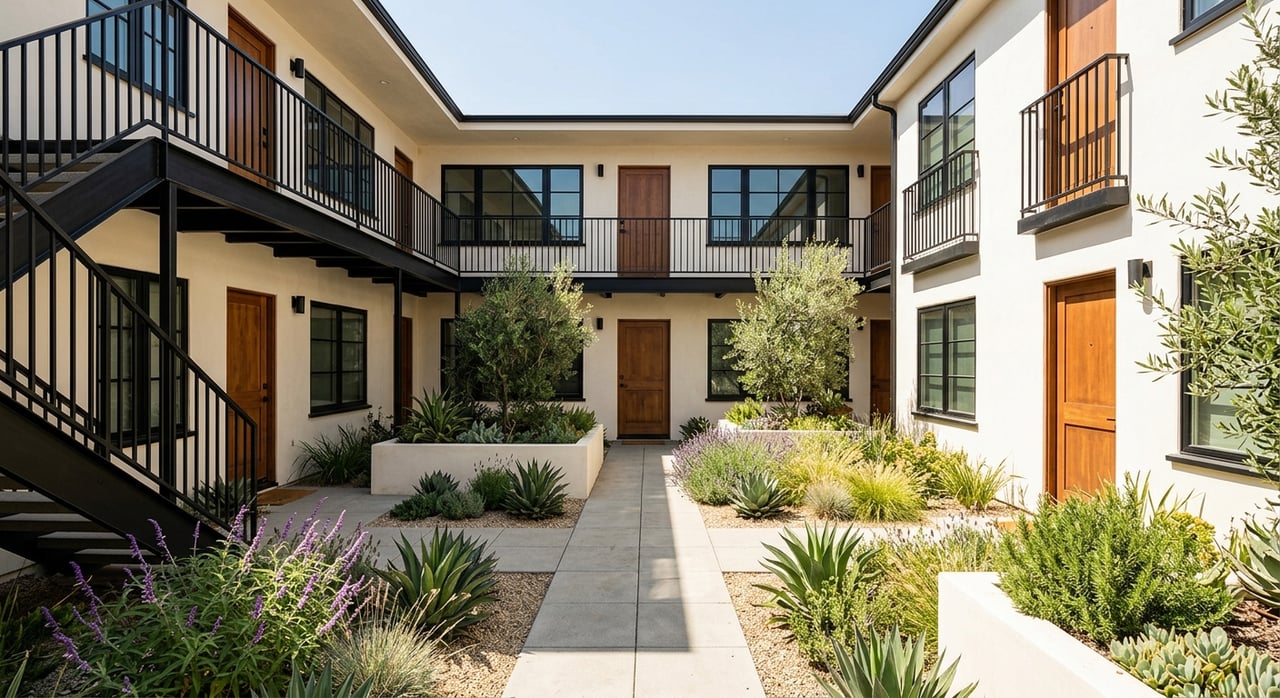
North Hollywood is not only a duplex and triplex market. Courtyard and garden-style buildings are part of the local mix, and these properties often compete based on parking, laundry, outdoor space, and overall setting rather than lot size alone.
That is important because tenant appeal in this submarket often comes down to practical livability. A well-kept courtyard building with gated access, parking, and usable outdoor areas may compare well against newer options, depending on unit condition and location.
One reason North Hollywood stays on investors’ radar is its broad pricing ladder. There are still entry points for smaller buyers, but pricing can move up quickly for renovated assets or properties in stronger locations.
Recent examples show two-unit properties selling around $825,000, with current asking prices roughly between $975,000 and $1.25 million in better-located pockets. Three-unit properties can still appear around $875,000.
That range gives you a sense of the market’s accessibility. Compared with pricier nearby Valley pockets, North Hollywood can still offer a path into multifamily ownership without immediately jumping into a larger apartment asset.
Four-unit buildings are typically around $1.0 million to $2.3 million, depending on renovation level and current income profile. Recent examples include a four-unit sale at just over $1.0 million and active listings above that level.
For five- to ten-unit assets, current pricing spans roughly $1.05 million to $1.8 million. A recent 15-unit sale closed at $3.61 million, which shows how quickly pricing scales once unit count and income increase.
Rentability in North Hollywood looks healthy, and that is a key part of the area’s appeal. RentCafe’s June 2026 data shows an average apartment rent of $2,504, with one-bedroom units at $2,284, two-bedroom units at $2,941, and three-bedroom units at $3,299.
The same data shows that 75% of households are renter-occupied, and the largest share of rentals falls between $2,001 and $2,500 per month. For an investor, that points to a deep renter base and a market where rental housing plays a major role.
North Hollywood also compares favorably to nearby Valley areas. Average rent is essentially the same as Valley Village at $2,501 and only modestly below Sherman Oaks and Studio City, which helps support the idea that North Hollywood can offer competitive rent levels without the same pricing basis in every pocket.
For many multifamily buyers, the most interesting part of the North Hollywood story is not just rent. It is the relationship between rent and acquisition cost.
Realtor’s March 2026 snapshot puts North Hollywood’s median listing price at $954,500, compared with $1,299,000 in Valley Village and $1,247,500 in Greater Toluca Lake. In the NoHo Arts District specifically, the median listing price was $899,000, with 52 homes for sale and 245 rentals.
That does not guarantee better performance, but it helps explain why North Hollywood often feels more investor-friendly than adjacent areas. If rents are broadly competitive and purchase prices are lower in certain pockets, the gross-yield picture may look more attractive, especially when operating costs stay under control.
If you are considering a remodel or repositioning strategy, current rental examples offer a useful reference point. Updated courtyard-style rentals show one-bedroom rents around $1,875 to $1,975 or more, while two-bedroom units range from about $2,145 to $2,695 or more, depending on finishes, parking, and location.
That gives you a rough ceiling for underwriting. In other words, if you are buying an older duplex or small apartment building, you want a clear picture of what realistic post-renovation rents could be rather than relying on best-case assumptions.
In North Hollywood, the market often rewards practical upgrades more than flashy ones. Current listings repeatedly point to value in features such as:
These are the details that can improve both rentability and resale appeal. In many older buildings, function and convenience can matter just as much as cosmetic updates.
In North Hollywood, underwriting is not just about purchase price and rent. Regulation is a major factor, especially because much of the small multifamily stock is older.
According to LAHD, units built on or before October 1, 1978 are generally subject to the city’s Rent Stabilization Ordinance. That can include duplexes, two or more single-family units on the same parcel, and ADUs and JADUs.
For RSO units, the allowable rent increase is 3% for July 1, 2025 through June 30, 2026. That means your rent growth assumptions need to be grounded in current local rules, not in a faster-growth scenario.
State law also affects your planning. California’s Tenant Protection Act caps annual increases at 5% plus inflation or 10%, whichever is lower, and limits owners to no more than two rent increases in a 12-month period.
For buyers, the takeaway is simple. If you are evaluating an older property, turnover strategy, capital improvement planning, and current tenant profile all matter just as much as the headline asking price.
In North Hollywood, the strongest-performing small multifamily assets usually combine location, functionality, and realistic income potential. The blocks closest to the Metro station and the NoHo Arts District continue to offer one of the clearest long-term demand stories.
At the same time, not every good opportunity sits in the most polished pocket. Some less prominent parts of 91601 and many properties in 91606 can still make sense when the layout is efficient, parking is adequate, and the basis leaves room for a sensible business plan.
The area’s planning direction also suggests continued change ahead. The draft community plan emphasizes infill, mixed-income housing, and ADUs and JADUs, which supports long-term housing demand but may also mean more competition from newer product over time.
Before you move on a property, it helps to pressure-test the basics with discipline. In a market like North Hollywood, small details can have a big impact on performance.
Answering these questions early can save you time and help you avoid overpaying for a deal that looks better on paper than it performs in practice.
North Hollywood is a neighborhood where block-by-block knowledge can make a real difference. Two properties with similar unit counts may have very different outlooks depending on street location, parking setup, tenant mix, transit access, and how local regulations affect future plans.
That is why many buyers benefit from working with someone who understands both the residential side of the Valley and the investment logic behind small multifamily assets. With broad experience across North Hollywood, Studio City, Toluca Lake, Sherman Oaks, and nearby neighborhoods, Tammy Jerome brings the local perspective and practical deal awareness that can help you evaluate opportunities with more confidence.
If you are exploring duplexes, triplexes, fourplexes, or value-add small apartment buildings in North Hollywood, connect with Tammy Jerome Real Estate for experienced, local guidance tailored to your goals.

August 21, 2026
Find out why your condo sale can stall even when your own balcony is perfectly safe.
August 20, 2026
August 13, 2026
August 6, 2026
August 6, 2026
July 23, 2026
July 16, 2026
July 9, 2026
July 2, 2026
Get assistance in determining current property value, crafting a competitive offer, writing and negotiating a contract, and much more. Contact me today.