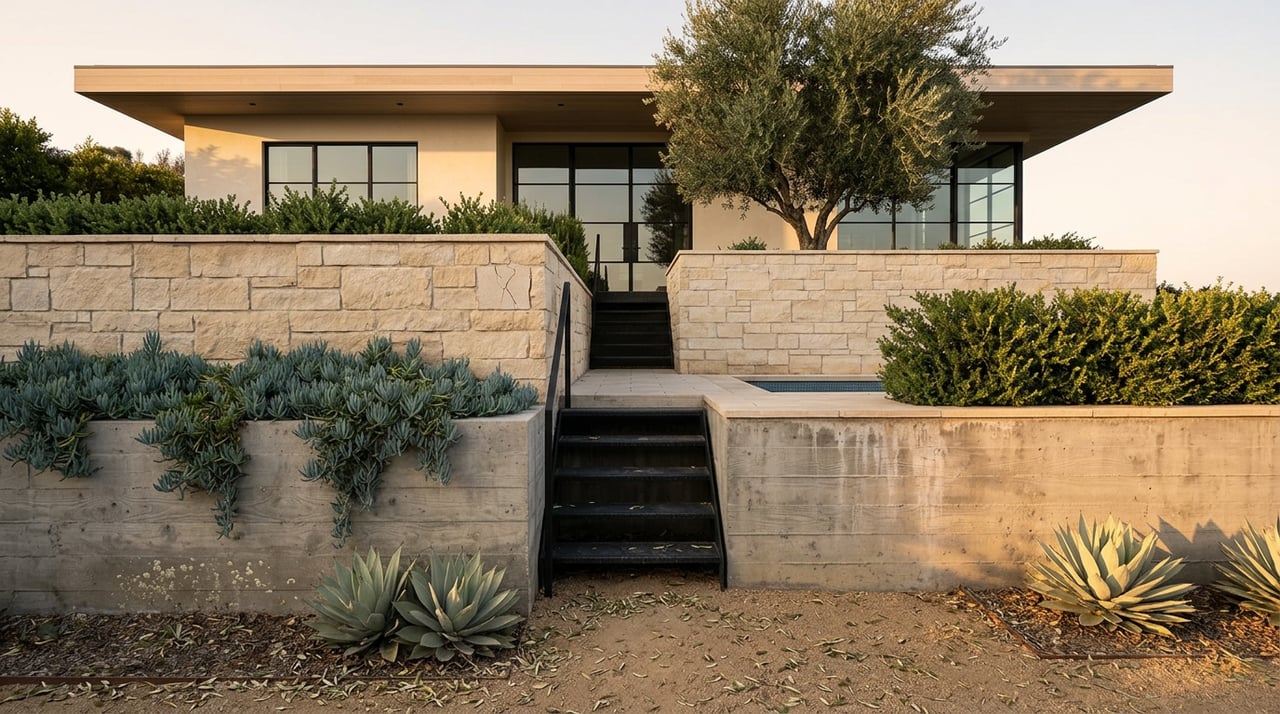
A Retaining Wall Just Failed on Wilcox Avenue. Here's What It Means for Your Hollywood Hills Escrow.
September 24, 2026
September 24, 2026
"The unfortunate part was there's report that this hose has been running for a long period of time. If you see something, say something."
That's LAFD Captain Milo Cope, describing how an unattended garden hose set off a chain reaction that most Hollywood Hills homeowners never think about until it happens on their own street.
On Friday afternoon, September 18, crews responded to 1925 N. Wilcox Avenue after a hose left running filled a swimming pool past capacity, sending roughly 7,000 gallons over the edge and into the hillside below. The saturated soil put pressure on a retaining wall. The wall gave way. Cinder blocks broke loose and came down through the roof of a vacant apartment building at the bottom of the slope. Eight units in the building above were evacuated as a precaution. A project manager on site, William Daher, noticed the overflow, shut off the water main, and flagged the collapse to arriving fire crews before anyone was hurt. Both the damaged building and the pool area were red-tagged, and residents were allowed back home later that day.
No one was injured. The building held. But the sequence, a hose, saturated soil, a wall, a building underneath, is the exact chain that shows up in almost every geotechnical report written for a hillside sale in this neighborhood. And right now, that chain is quietly knocking a share of Hollywood Hills contracts out of escrow before they ever reach the closing table.
Buyer demand for Hollywood Hills homes has not disappeared. Zillow's own tracking, updated at the end of July 2026, shows the average home value holding near $1.95 million, down only 0.3% over the prior year, and listings moving to pending in around 44 days. That is not a market where buyers have gone quiet.
The odd part shows up once a deal is actually in contract. Redfin's neighborhood data shows homes that do close are selling after 59 days on market on average, which is faster than the 67 days recorded over the same stretch a year earlier. Median sale price came in at $1.7 million over the trailing three months, down about 4.5% year over year. And yet the count of completed sales dropped hard: Redfin logged 70 closed sales in June 2026, down from 85 in June 2025.
Put those side by side and a different pattern shows up:
| Signal | What it measures | Recent figure |
|---|---|---|
| Zillow days to pending | How fast a listing gets an accepted offer | About 44 days (as of July 2026) |
| Redfin days on market | Time to close, among sales that complete | 59 days, actually down from 67 a year earlier |
| Redfin homes sold, June | Completed transactions | 70, down from 85 in June 2025 |
Buyers are still showing up on a normal timeline, and the deals that make it to closing are closing about as fast as ever, if not a little faster. What's dropped is the number of contracts that make it all the way to a closed sale. Something is knocking deals out of the pipeline before the finish line, and it has very little to do with buyers cooling on the Hills.
Under the city's hillside building rules, any retaining wall over 4 feet requires an engineered design and a permit from the Los Angeles Department of Building and Safety. New construction and major additions in a designated Hillside Area also require a geotechnical investigation report, typically running $5,000 to $15,000 depending on how complex the site is. Without that report, LADBS will not accept a permit application at all.
A few years ago, plenty of buyers waived their inspection contingency within the standard window and moved on. That's getting harder to justify. Buyers working with informed agents are now routinely asking for a geotechnical consult and a pull of the permit history on any existing retaining wall before they remove contingencies. When that review turns up unpermitted work or a wall showing real signs of stress, a lot of buyers simply walk rather than stick around to negotiate a fix. A retaining wall failure can cost $50,000 to $100,000 or more to repair, and that is not a number most buyers want to inherit mid-escrow. That is very likely where the missing sales are going: not into longer closings, but into contracts that end before they get there.
Part of why this review carries real weight is the ground itself. The Hollywood Hills sit on a mix of colluvium, soil that has slowly crept downhill over time, and alluvial deposits in the canyon bottoms, and the composition can change completely within a single lot. Two soil borings fifty feet apart on the same property can turn up different depths to bedrock and different groundwater conditions, which is why a thorough geotechnical review on a Hills lot often needs more exploration than a similar-sized property on flatter ground.
California requires every seller of a 1-4 unit property to complete a Transfer Disclosure Statement covering the roof, drainage, foundation, and any known water intrusion or settling, filled out personally by the seller rather than an agent. Every sale also requires a statewide Natural Hazard Disclosure identifying whether the property sits in any of six designated hazard zones, including seismic hazard zones tied to landslide risk.
For Hollywood Hills sellers specifically, that paperwork tends to go further in practice. Past soil movement, drainage problems, and any retaining wall installed to manage slope creep belong in the seller's own disclosure, not left for a buyer's inspector to discover mid-escrow. Full disclosure up front does more for a seller than protect against a future claim. It narrows the list of things a buyer can use to renegotiate or walk once they're already in contract, which matters even more in a year when a growing share of Hollywood Hills contracts appear to be falling out before closing rather than dragging on.
A single median price or a single days-on-market figure for "Hollywood Hills" flattens a neighborhood that isn't really one market. Laurel Canyon, Beachwood Canyon, Outpost Estates, Whitley Heights, the Bird Streets, Hollywood Dell, and Hollywoodland each carry their own mix of terrain, access, and architecture, and given how much the soil itself can vary lot to lot, the diligence timeline on a Whitley Heights Spanish Revival can look nothing like the timeline on a newer build in the Bird Streets, even if both listed the same week.
That's the part a headline price can't capture. It's also the part that determines whether a given contract survives its contingency period or ends up back on the market.
The wall on Wilcox Avenue had presumably held for years until one hose changed the math overnight. That's the risk every retaining wall in this neighborhood carries in some form, and it's very likely part of why fewer Hollywood Hills contracts are making it to a closed sale this year even though the ones that do close are closing about as fast as ever. That's not a market slowing down for no reason. That's the market doing the work it should have been doing all along.
Does the drop in completed sales mean prices are falling across the Hills? Not by much, and not evenly. Redfin's data shows a modest 4.5% year-over-year dip in median sale price, while Zillow's tracking shows values essentially flat and listings still reaching pending in about 44 days. The bigger shift is in how many contracts make it all the way to a closed sale, not in how quickly buyers are willing to make an offer or how much they're willing to pay for one that closes.
How much should I budget for a geotechnical report before I remove contingencies? Plan on $5,000 to $15,000, depending on the size and complexity of the lot. It's a real cost, but it's small next to the $50,000 to $100,000-plus a retaining wall failure can run to repair.
What size retaining wall actually needs a permit? Any wall over 4 feet in height needs an engineered design and a permit from LADBS under the city's hillside construction rules. You can check whether a specific property falls within a designated Hillside Area using the city's ZIMAS mapping tool before you write an offer.
If you're weighing a hillside purchase or getting a Hollywood Hills listing ready this fall, it helps to walk the disclosure package and the wall's permit history with someone who reads these reports for a living. Tammy Jerome has spent more than two decades in Los Angeles hillside transactions and can help you sort out what's routine paperwork and what's worth a second opinion before you're locked into a contract. Let's connect.
September 24, 2026
September 17, 2026

September 12, 2026
It's not just about sitting on the market longer. Overpricing can quietly cost you money, negotiating power, and the one window you can't get back.
September 12, 2026
Selling a condo isn't just selling a smaller house. You're selling a unit, a building, a community, and a financial ecosystem all at once. Here's how to get it right.

September 12, 2026
When one spouse or sibling isn't on board, selling becomes less about real estate and more about communication, timing, and strategy.

September 12, 2026
Hoping the market sorts itself out usually means fewer showings and lower offers. Here's what a real listing plan does instead.

September 12, 2026
It sounds precise, and it's the number everyone reaches for. But lean on it too hard when buying or selling in LA, and it can quietly steer you off course.

September 12, 2026
Some neighborhoods attract buyers no matter what the market is doing. Here's what sets them apart and what it means for your home.
September 10, 2026
Get assistance in determining current property value, crafting a competitive offer, writing and negotiating a contract, and much more. Contact me today.